Our Products
Explore our comprehensive range of premium edible oils, plant-based waxes, and industrial petrochemical waxes.
Showing 1–20 of 23 products

Beeswax
Beeswax (CAS 8012-89-3 yellow, 8006-40-4 white; INCI Cera Flava and Cera Alba) is secreted by worker honeybees to build comb. It melts at 61 to 65 degrees Celsius and is the reference natural wax for candles, cosmetics and polishes.

Coconut Wax
Coconut wax (CAS 84836-98-6, INCI Hydrogenated Coconut Oil) melts at just 38 to 42 degrees Celsius, the softest of the common vegetable candle waxes. That low melt gives outstanding fragrance throw but makes it unsuitable on its own for pillars.

Soy Wax
Soy wax (CAS 8016-70-4, INCI Hydrogenated Soybean Oil) is soybean oil hardened by hydrogenation. Supplied as blocks, flakes or pellets with melting points from 42 to 58 degrees Celsius, it is the default natural wax for container candles.

Rapeseed Wax
Rapeseed wax is hydrogenated rapeseed oil, supplied as blocks melting at 42 to 52 degrees Celsius or pellets at 52 to 60. European-grown and vegan, it has become the preferred soy alternative for candle makers sourcing within Europe.

Hydrogenated Castor Oil (Castor Wax)
Hydrogenated castor oil (CAS 8001-79-4, INCI Hydrogenated Castor Oil), known as castor wax, melts at 85 to 88 degrees Celsius, the highest of the common vegetable waxes. Hard, brittle and water-insoluble, it structures and thickens at low addition.

Rice Bran Wax
Rice bran wax (CAS 8016-60-2, INCI Oryza Sativa Bran Wax) is recovered during the refining of rice bran oil. Melting at 77 to 82 degrees Celsius, it is a hard vegan wax valued for its ability to gel liquid oils at very low addition.

Sugarcane Wax
Sugarcane wax (INCI Saccharum Officinarum Cera) is recovered from the filter press mud left over from sugar milling. Melting at 76 to 82 degrees Celsius, it is a hard, glossy vegan wax with a composition close to carnauba.

Sumac Wax
Sumac wax (CAS 8001-39-6, INCI Rhus Succedanea Fruit Wax), traditionally called Japan wax, is pressed from the berries of the wax tree. Despite the name it is a fat rather than a true wax, which gives it an unusually soft, tacky character.

Sunflower Wax
Sunflower wax (CAS 91082-37-0) is recovered when sunflower oil is winterised. Melting at 74 to 77 degrees Celsius, it is among the most efficient natural oil structurants known, forming a firm gel at additions of only a few percent.

Candelilla Wax
Candelilla wax (CAS 8006-44-8, INCI Euphorbia Cerifera Wax) is scraped from the stems of a desert shrub that grows in northern Mexico. Hard, brittle and vegan, it is the usual plant-based replacement for beeswax in cosmetics.

Synthetic Beeswax
Synthetic beeswax (INCI Synthetic Beeswax) is a blended wax engineered to reproduce the melting point, texture and ester profile of natural beeswax at 61 to 65 degrees Celsius, with consistency natural beeswax cannot offer.

Synthetic Vegan Beeswax
Synthetic vegan beeswax (INCI Synthetic Beeswax) reproduces the 61 to 65 degree melting point and working texture of beeswax from entirely non-animal ingredients, for formulations that must carry a vegan or cruelty-free claim.

Palm Sand Wax (Crystal Wax)
Palm sand wax, also called crystal wax (CAS 8021-56-5, INCI Hydrogenated Palm Oil), is uncoloured granulated palm wax melting at 56 to 60 degrees Celsius. It is used cold, poured around a wick, and takes added colour and fragrance readily.

Carnauba Wax
Carnauba wax (CAS 8015-86-9, INCI Copernicia Cerifera Wax) is harvested from the leaves of the Brazilian carnauba palm. Melting at 82 to 86 degrees Celsius, it is the hardest natural wax in commercial use and gives the highest gloss.

Palm Wax
Palm wax (CAS 8021-56-5, INCI Hydrogenated Palm Oil) is hydrogenated palm oil, supplied in melting bands from 42 to 60 degrees Celsius. It is the only common vegetable wax that forms a decorative crystalline pattern as it sets.

Cocoa Butter Substitute (CBS)
Cocoa butter substitute is a lauric hard fat made by fractionating and hydrogenating palm kernel oil. It mimics the sharp body-temperature melt of cocoa butter without requiring tempering, but cannot be blended with real cocoa butter.

Colourful Sand Wax
Colourful sand wax (CAS 8021-56-5, INCI Hydrogenated Palm Oil) is a granulated palm wax supplied in more than fifteen colours. It is poured cold around a wick like sand, with no melting equipment required at any stage.
Palm Kernel Stearin
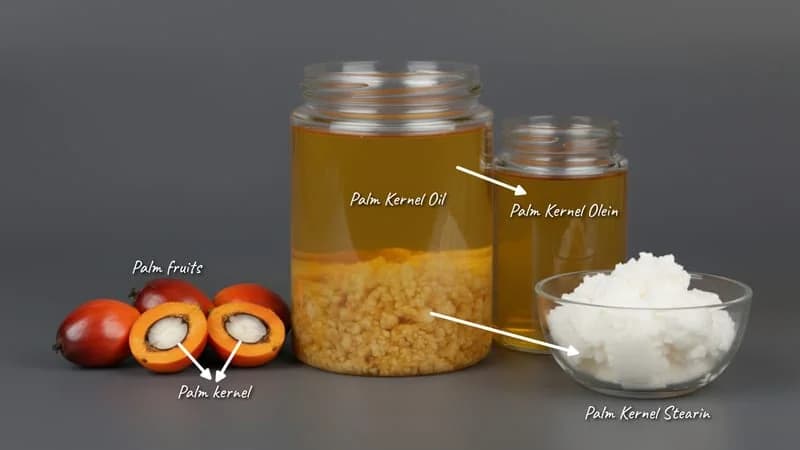
Palm kernel stearin is the hard fraction of palm kernel oil, with lauric acid at 46 to 52 percent and an iodine value of only 5 to 9. It melts at 30 to 34 degrees Celsius and is the base for cocoa butter substitutes and hard lauric soap.

Palm Stearin
Palm stearin is the hard fraction of palm oil, rich in palmitic acid with an iodine value typically below 48. In candle and soap manufacture it is the cheapest bulk source of the saturated C16 chains that give hardness and opacity.

Palm Shortenings(high melting point)
High melting point palm shortening is a texturised blend of palm stearin and palm oil fractions. Its high solid fat content at elevated temperature is what lets laminated pastry and biscuits hold structure through a warm bakery and the oven.